Recycling and Sustainability for Garden Maintenance Kingston
 Garden Maintenance Kingston is committed to building an eco-friendly waste disposal area and a truly sustainable rubbish gardening area. We describe here how our Kingston garden maintenance teams sort, reuse and divert green waste from landfill while supporting local circular-economy projects. Our approach combines practical site-level recycling with strategic partnerships to make garden services in Kingston greener and more transparent.
Our policy balances day-to-day lawn and hedge work with strong recycling targets. We aim to meet a bold recycling percentage target of 65% by 2030 across all garden waste streams, including wood, green cuttings and compostable packaging from site operations. That target informs routing, on-site separation and our investment in low-carbon fleet options for sustainable garden maintenance in Kingston.
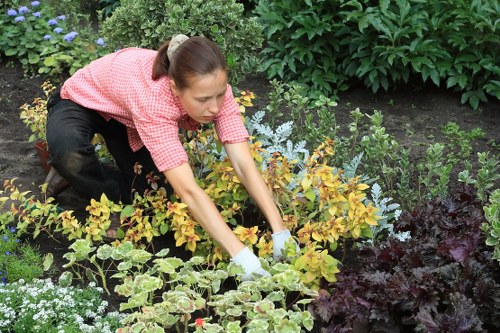 Kingston garden maintenance teams use clear on-site separation systems: containers for green waste, a separate bay for timber and brash, and a small but dedicated line for clean inert materials. This mirrors the boroughs' approach to waste separation, where local authorities encourage residents and contractors to separate food, recycling and residual waste. Working with the boroughs' guidance keeps our disposal streams compliant and efficient.
We prioritise local transfer stations to shorten haul distances and cut emissions. Typical movements are directed to the Kingston Recycling Centre and neighbouring transfer facilities that accept garden and wood waste for onward processing. Using local transfer stations reduces vehicle miles and ensures green materials are taken to composting or biomass partners rather than landfill.
Our service model includes practical separation measures on every job: bagged compostables, labelled bulk containers for mixed green waste and a separate skip for recyclable wood. The on-site items are then documented and routed to the appropriate local transfer station. This chain of custody helps us track progress toward our recycling rate and gives transparency for sustainable rubbish gardening area metrics.

Partnerships with charities and community projects
We work closely with local charities and community groups to maximise reuse. Usable timber and larger branches are offered to community allotments, social enterprises and environmental charities that run habitat projects. Smaller organic materials are donated where appropriate to community composting schemes or used to support food growing projects, creating a closed-loop for garden maintenance Kingston services.Beyond donations, we maintain formal partnerships with regional recycling processors and community organisations to ensure accountable reuse. A list of typical activities includes:
- Delivery of clean wood to local biomass partners
- Donation of large reusable timber to community garden projects
- Supply of screened compost to local allotments and neighbourhood planting schemes
To reduce operational emissions we are transitioning to a low-carbon van fleet. Our Kingston teams use a mix of electric vans for short urban runs and ultra-low emission hybrids for longer or heavier jobs. This reduces fuel consumption and local air pollution, supporting the boroughs' wider environmental ambitions and improving the carbon footprint of every service visit.
Practical sorting and on-site behaviour
On every job our crew follows a simple hierarchy: reduce, reuse, recycle. That means minimising packaging brought to site, reusing salvaged materials where safe and recycling the remainder. Workers are trained to segregate soil and aggregates from compostables and keep potential contaminants — like plastic pots or treated timber — out of organic streams to protect compost quality. Monitoring and continuous improvement is central to our sustainable garden maintenance Kingston programme. We audit loads, log destinations and calculate diversion rates regularly. These records help us refine routes to local recycling centres, improve separation at source and hit our recycling percentage target. Regular reviews also inform staff training and investment in better containment and signage on vans and at sites.
We embrace the borough-level guidance on waste separation, which encourages source segregation of organics, dry recycling and residual waste. By aligning our on-the-ground practices with that framework we reduce contamination and increase the value of separated materials. This makes recycling more effective for the entire local system and supports Kingston's environmental goals.
In summary, our approach to an eco-friendly waste disposal area and sustainable rubbish gardening area for garden maintenance in Kingston combines clear on-site sorting, use of nearby transfer stations, charitable partnerships and a low-emission van fleet. We are committed to achieving and exceeding our recycling targets while delivering the quality landscaping and green-space care the community expects.